About this post
Source links and review dates are included so you can check the details. Confirm requirements with the relevant agency, payer, or vendor before acting.
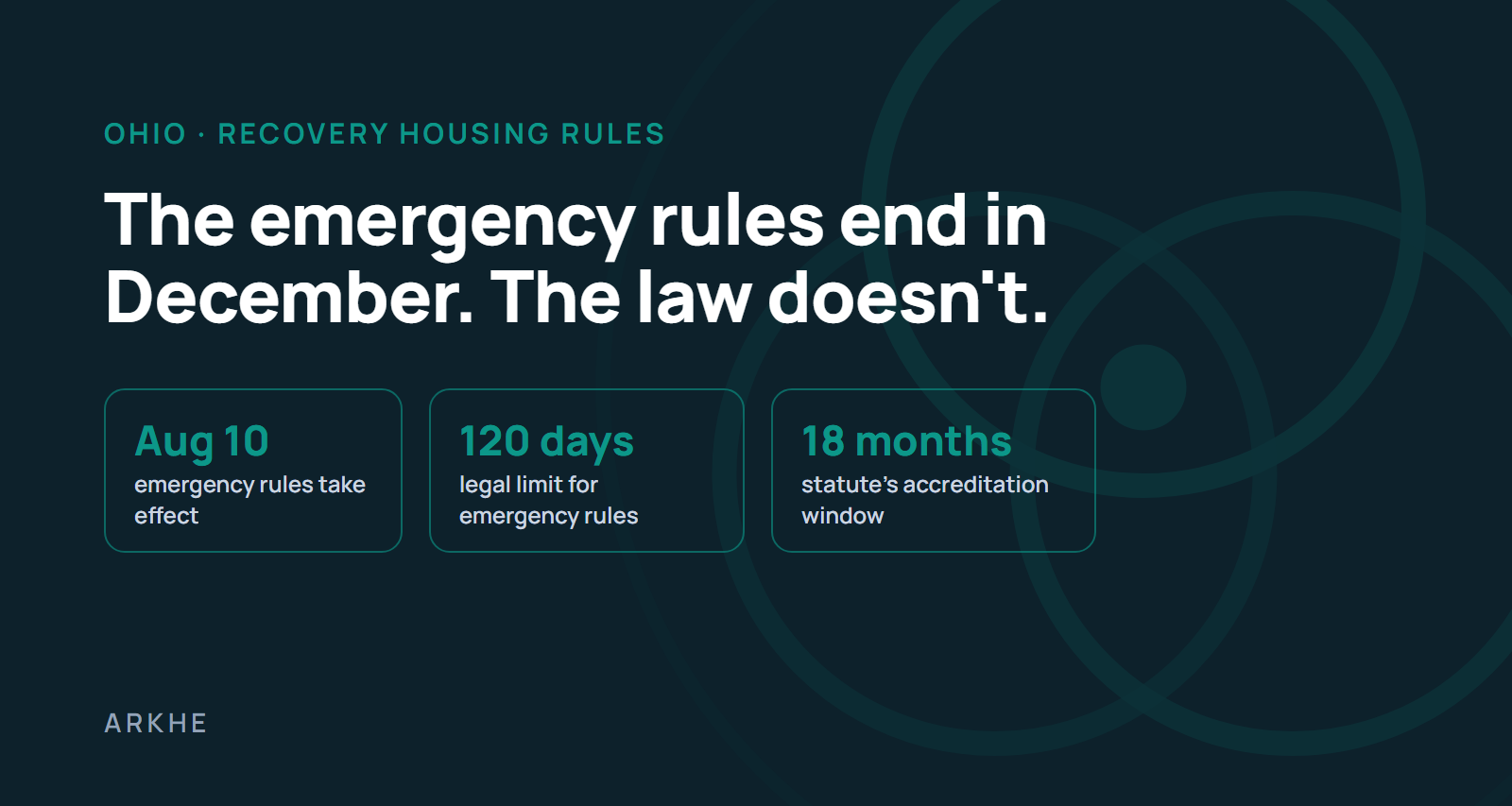
Since August 10, 2026, Ohio's Department of Behavioral Health (DBH) has certified recovery housing residences directly, under emergency rules in Ohio Administrative Code (OAC) Chapter 5122-31. Ohio law limits emergency rules to 120 days, so these rules run out in early December 2026 unless DBH adopts permanent rules first. The statute behind them stays in force either way. Here is what each one requires and what an Ohio operator should do now.
This post is general information, not legal advice. Rules can change quickly; check the linked sources or ask DBH or qualified counsel about your situation.
What changed in August 2026
On August 10, 2026, Executive Order 2026-03D let DBH adopt OAC 5122-31-01 to 5122-31-24 immediately, as emergency rules. Before that, operators met Ohio's requirements through accreditation from Ohio Recovery Housing or an Oxford House charter. Under the emergency rules:
- Every recovery housing residence is covered, "regardless of whether the structure holds itself out to be, or represents itself as, a recovery housing residence" (OAC 5122-31-01).
- Accreditation is part of the application. The DBH application must include proof of full accreditation in good standing from an organization named in Ohio Revised Code (R.C.) 5119.39 (OAC 5122-31-03).
- The fee is $15 per bed, nonrefundable, and full certification lasts two years. Renewal applications are due at least 90 days before expiration (OAC 5122-31-03 and 5122-31-04).
- Operating standards cover fire safety, bedrooms and bathrooms, staffing, resident rights and grievances.
- Civil penalties are $500 for a first offense and $1,000 for each offense after that, plus the same amount for each 30 days a penalty goes unpaid (OAC 5122-31-08).
- The 18-month test. A residence that is still uncertified 18 months after its first resident moved in is in violation (OAC 5122-31-08).
Sources: S1, S2, S3
Why the rules expire
Ohio's rulemaking law says an emergency rule "shall become invalid at the end of the one hundred twentieth day it is in effect" (R.C. 119.03(G)). For rules effective August 10, that lands around December 8, 2026; some published summaries give December 9. Two things follow from the same section:
- DBH can make them permanent. Before the 120 days run out, DBH may adopt the rules as regular rules through the normal process, which includes public notice, a hearing and review by the legislature's Joint Committee on Agency Rule Review (JCARR).
- DBH can't simply renew them. The law bars an agency from re-adopting the same emergency rule so that it continues "without interruption for another one-hundred-twenty-day period."
As of November 6, 2026, every rule in OAC 5122-31 still shows as an emergency filing, and we found no permanent version in effect. Permanent rules may still arrive before December, and they may differ from the emergency version.
Sources: S1, S3, S4
What stays law either way
The emergency rules carry out R.C. 5119.39 to 5119.397. Those sections are statutes passed by the General Assembly, so they don't expire with the rules. Under them:
- The operating requirement has applied since January 1, 2025. No one may operate a recovery housing residence unless it is certified by DBH (when DBH certifies) or accredited by Ohio Recovery Housing (Ohio's NARR affiliate), Oxford House, Inc., or another DBH-designated organization (R.C. 5119.39 and 5119.392).
- The 18-month window is in the statute. A residence may operate for up to 18 months from its first resident's move-in while it is "actively engaged in efforts to obtain certification or accreditation" (R.C. 5119.392).
- You must register with DBH within 30 days after the first resident begins living in the residence, on DBH's form (R.C. 5119.391).
- DBH keeps a public registry of residences that meet the requirements, and removes those that stop meeting them (R.C. 5119.394).
- Advertising and referral restrictions in R.C. 5119.395 and 5119.396 have applied since January 1, 2025.
- Enforcement under the statute is an injunction. DBH can ask the Ohio Attorney General to go to court to stop an operator (R.C. 5119.392). The $500 and $1,000 civil penalties come from the emergency rule, not the statute.
Sources: S4, S5
The open question if the rules lapse
The statute lets DBH monitor recovery housing in one of two ways: by certifying residences "through a process established by the department," or by accepting accreditation from Ohio Recovery Housing, Oxford House or another designated organization (R.C. 5119.39). The certification route depends on rules for its requirements. If the emergency rules lapse before permanent rules take effect, DBH would have no certification process in rule, and it hasn't said publicly how it would handle that gap.
What doesn't change is the baseline: an Ohio recovery residence needs accreditation, or must be within its first 18 months and working toward it.
Sources: S1, S4
What Ohio operators should do now
The same steps hold up whether permanent rules arrive in December or later:
- Register with DBH if you haven't. The statute requires it within 30 days after your first resident moves in.
- Find your 18-month date. Count 18 months from the first move-in on your registration form. That is the statute's deadline for accreditation, and the emergency rules use the same date for certification.
- Get or keep accreditation. It is required under the statute and part of the DBH application under the rules.
- Keep preparing for DBH certification. Fire safety, room sizes, resident rights and grievance procedures are likely to stay in some form, so the work isn't wasted.
- Watch for the permanent rules. Proposed rules and hearing notices are published in the Register of Ohio. We'll update this post when they take effect.
Our Ohio recovery housing guide has the full opening checklist, the DBH and county board contacts, and Ohio funding sources.
Accreditation and certification both come down to records you can produce on request: signed resident agreements, rights acknowledgments, grievances and incident logs. See how ARKHE keeps signed forms and documents and records for outside reviewers in one place. Software doesn't make a house compliant, but it keeps the proof findable.
Sources: S1, S4, S5
Common questions
Do Ohio's recovery housing rules expire in December 2026?
The emergency rules in OAC Chapter 5122-31 become invalid after 120 days in effect, around December 8, 2026, unless DBH adopts permanent rules first. The statute requiring certification or accreditation, R.C. 5119.39 to 5119.397, does not expire.
Sources: S1, S3, S4
Can I operate an Ohio recovery home without accreditation if the rules lapse?
Only within the statute's 18-month window, and only while actively working toward certification or accreditation. After that, R.C. 5119.392 bars operating without it, and the Attorney General can seek an injunction.
Sources: S4
Are the $500 and $1,000 penalties in the statute?
No. They are in emergency rule OAC 5122-31-08. The statute's enforcement tool is a court injunction requested through the Attorney General.
Sources: S1, S4
Who accredits recovery housing in Ohio?
The statute names Ohio Recovery Housing (the Ohio affiliate of the National Alliance for Recovery Residences), Oxford House, Inc., and any other organization DBH designates.
Sources: S4
Sources
- S1, Ohio Administrative Code: Chapter 5122-31, Recovery Housing Residences (emergency rules effective August 10, 2026)
- S2, Office of Governor Mike DeWine: Executive Order 2026-03D
- S3, National Law Review: State of Ohio Announces Emergency Rules Requiring Department of Behavioral Health Certification for Recovery Housing Residences
- S4, Ohio Revised Code: Section 5119.39, 5119.391, 5119.392, 5119.394 and 119.03
- S5, Ohio Revised Code: Section 5119.395, 5119.396 and 5119.397
Keep exploring